
















SIMULATION / FREE / MIT EXAMPLE SOURCE
Synapse
See a network learn
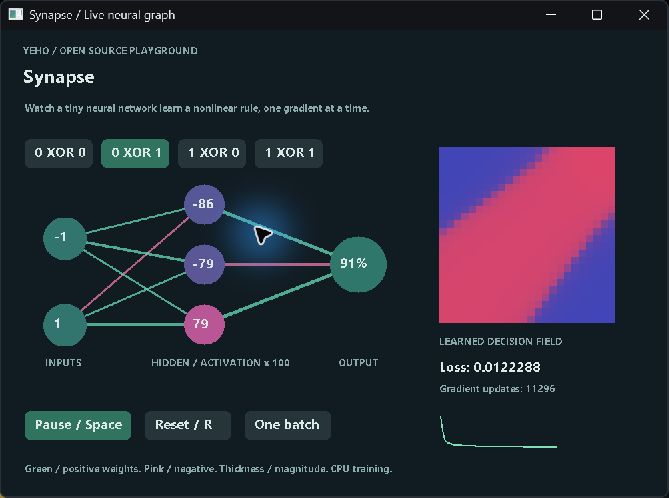
A real 2 → 3 → 1 network learns XOR while its weights, activations, loss curve, and decision field change live.
Take it for a spin.
Space pauses training, R resets weights, and One batch performs four gradient updates. Choose an input pair to inspect its activations.
Extract the Windows download to a writable folder and open neural-graph.exe. Escape closes it. Database examples keep their local data in the working folder.
See how it works.
Hidden layers, softsign activation, backpropagation, squared-error gradients, and nonlinear decision boundaries.
Small deterministic CPU training. The separate first-steps flying-dot lesson demonstrates GPU compute training.
READ / CHANGE / UNDERSTAND
The whole example is yours.
These are the exact files in the source download. Start with the model, then follow the window’s event loop. Comments explain the decisions.
// A 2 -> 3 -> 1 network learns XOR. Unlike a single linear neuron,
// the hidden layer can bend the decision boundary into two separate regions.
// Softsign is a smooth activation without an exponential dependency.
Softsign(float x) returns float
{
    return x/(1.0+Math.AbsFloat(x))
}
Slope(float activation) returns float
{
    float remainder=1.0-Math.AbsFloat(activation)
    return remainder*remainder
}
class Network
{
    list of float weights=[]
    list of float hidden=[0.0,0.0,0.0]
    float output=0
    int steps=0
    Network()
    {
        this.Reset()
    }
    Reset()
    {
        this.weights=[0.4,-0.6,0.2,-0.3,0.7,-0.4,0.8,0.5,0.1,0.6,-0.8,0.3,0.0]
        this.steps=0
    }
    Predict(float x,float y) returns float
    {
        float sum=this.weights[12]
        for j from 0 < 3
        {
            this.hidden[j]=Softsign(this.weights[j*3]*x+this.weights[j*3+1]*y+this.weights[j*3+2])
            sum=sum+this.hidden[j]*this.weights[9+j]
        }
        this.output=Softsign(sum)
        return this.output
    }
    Train(float x,float y,float target,float rate)
    {
        float prediction=this.Predict(x,y)
        // For L = 1/2 (prediction-target)^2, the chain rule multiplies
        // output error by the activation derivative, then each upstream weight.
        float delta=(prediction-target)*Slope(prediction)
        for j from 0 < 3
        {
            float upstream=delta*this.weights[9+j]*Slope(this.hidden[j])
            // Calculate the hidden gradient before changing the outgoing weight.
            this.weights[j*3]=this.weights[j*3]-rate*upstream*x
            this.weights[j*3+1]=this.weights[j*3+1]-rate*upstream*y
            this.weights[j*3+2]=this.weights[j*3+2]-rate*upstream
            this.weights[9+j]=this.weights[9+j]-rate*delta*this.hidden[j]
        }
        this.weights[12]=this.weights[12]-rate*delta
        this.steps=this.steps+1
    }
    Loss() returns float
    {
        float total=0
        for sample from 0 < 4
        {
            float x=Math.IntToFloat(sample/2)*2.0-1.0
            float y=Math.IntToFloat(sample-sample/2*2)*2.0-1.0
            float target=-1
            if x!=y
            {
                target=1
            }
            float difference=this.Predict(x,y)-target
            total=total+difference*difference*0.125
        }
        return total
    }
    Batch()
    {
        for sample from 0 < 4
        {
            float x=Math.IntToFloat(sample/2)*2.0-1.0
            float y=Math.IntToFloat(sample-sample/2*2)*2.0-1.0
            float target=-1
            if x!=y
            {
                target=1
            }
            this.Train(x,y,target,0.15)
        }
    }
}
Wire(int x,int y,int tx,int ty,float weight)
{
    int r=103
    int g=213
    int b=183
    if weight<0
    {
        r=229
        g=124
        b=168
    }
    int thickness=1+Math.RoundToInt(Math.MinFloat(Math.AbsFloat(weight),4.0))
    DrawLineRgba(x,y,tx,ty,thickness,r,g,b,150)
}