















Private product showcase / Experimental research project
Qube
Quantum Computer
Next-generation quantum computing or better. A whole computer, reimagined for everyone.
An owned computer family and a visual workshop for designing it. Playfully, call yours a quby. Kids and grown-ups are equally welcome.
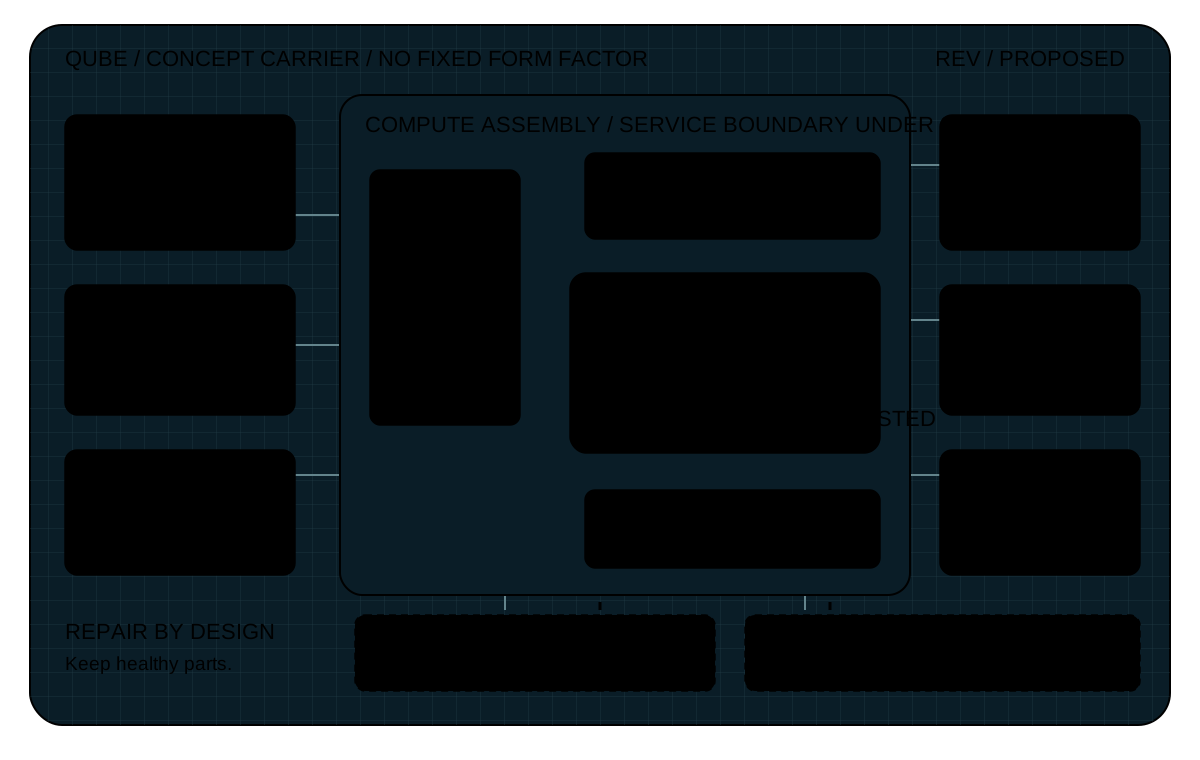
The whole computer, connected
Open the blueprint.
Explore the system, board, SoC, execution, repair and space views. Select a subsystem to see its purpose, interfaces and the next experiment needed to prove it.
Concept diagrams, not a manufactured board. Includes the proposed version sequence and lessons from early computers.
Qube is an experimental research project. Its source repository is private; a verified member archive has not been published yet. Physical boards and chips are future milestones. The design includes optional current-generation NVIDIA PCIe expansion beside our GPU, Wi-Fi and Bluetooth modules, and an owned wireless VR link. An open sensor-module system would let people build everything from touch and depth sensors to ultrasound, lidar, infrared, quantum sensors, and space observatories, with capabilities and calibration people can inspect. Quantum networking, synchronization, and three-dimensional antennas are research directions. Instant interstellar messaging and 10,000-times-faster-than-fiber communication are aspirations without a demonstrated mechanism; known quantum physics does not permit entanglement to carry controllable messages faster than light. These capabilities are not implemented by today’s simulator.
Why this changes the game
Three reasons to care.
Explore the whole computer, from shared compute and memory to repairable modules.
Run a tiny workload through three memory policies and inspect every logical copy.
Co-design Yeho, Starfish and hardware from simulator to FPGA, development chip and qualified profiles.
Proof today
The current machine, without mythology.
The working Windows CPU-reference designer has a sixteen-area overview, draggable cards, smooth zoom, saved layouts, board and SoC sketches, and a four-operation execution view. Its Yeho graph simulator passes 216 configurations. Shared, explicit-copy, and combined-copy policies preserve the example’s values while counting logical data movement. General graphs run separately from the native UI today. This is a functional graph model, not an ISA simulator or a booted Starfish machine. FPGA, a manufacturable chip, optical computing, quantum modules, holographic displays, demonstrated physical repairs and space qualification remain development or research goals.
A language, operating system, and chip should help each other. The aim is an affordable, highly repairable family that grows from tiny sensors to creative, gaming, VR, AI and mission-qualified space configurations.
A Yeho and Dolphin designer makes the blueprint tangible: move components, pan and zoom, compare memory choices, and attach experiments to observable results. Shapes, modules, cooling and connections are designed together, free from ATX and ITX constraints. Accessible parts, documented diagnostics, compatible replacements and offline recovery make repair a requirement from the first design.
The connected stack
Nothing powerful lives alone.
The door is open