
















Private product showcase / Verified bounded intelligence
Yodi
The world’s first truly personal and private, ever-learning, tiny, hyper-fast AI framework, built with Yeho.
A team of inspectable local AI specialists
Why this changes the game
Three reasons to care.
Build a crew of specialized Yodis instead of one opaque giant.
Inspect every input, output, lever, loss, dataset, tensor, and parameter coordinate.
Run bounded intelligence across CPU, real Vulkan, and native Kyber with exact parity.
Proof today
The current machine, without mythology.
Executable proofs cover rights-bearing data, float training, compact model and tokenizer tournaments, exact checkpoint resume, a 6,000-byte sequence model, 512-byte plastic reasoning, owner-filtered DynaCapDB memory, six modality families, ordered serving/backpressure, real Vulkan kernels, native Kyber, exact backend agreement, and a manifest that rejects undocumented neural levers. General intelligence and OS-wide control remain North Stars.
A giant black box is expensive, hard to inspect, hard to specialize, and unsafe to place near private work, creative truth, machines, or operating-system control.
Yodi treats intelligence as a workshop of small inspectable machines: rights-aware data, measured tournaments, governed memory, documented Neural Boards, deterministic fallbacks, specialized bundles, and typed proposals before any product accepts a change.
The connected stack
Nothing powerful lives alone.
Public Academy
Learn Yodi from the inside.
Every public guide, field lesson, and architecture map for this system is gathered here. No membership is required to study these rooms.
Yodi: a guide to inspectable AI and governed memory
Understand Yodi's small AI models, visible learning mechanisms, governed memory, and bounded evaluations. A public guide for teams exploring inspectable AI source.
Open in the Academy ↗02 / Field lessonSource-code licensing for companies and government teams
A practical guide to evaluating Demon Hunter Labs source memberships: commercial and public-sector rights, team seats, release scope, and the evidence to request before adoption.
Open in the Academy ↗03 / Field lessonTesting access-controlled memory for private AI
A practical evaluation of owner filtering, expiry, restart, and source attribution in AI memory, using the bounded Yodi and DynaCapDB evidence as a starting point.
Open in the Academy ↗04 / Field lessonYodi: Build the Mind, Label Every Lever
Learn why Yodi favors compact specialists, inspectable Neural Boards, bounded memory, explicit evaluation, and documented controls over one mysterious giant model.
Open in the Academy ↗05 / Architecture mapYodi interactive architecture
Select stations, trace routes, and see which layer owns each important Yodi decision.
Open in the Academy ↗Open the machinery
Follow the whole system.
See the route first. Then open the architecture or complete manual when you want every chamber, boundary, and proof.
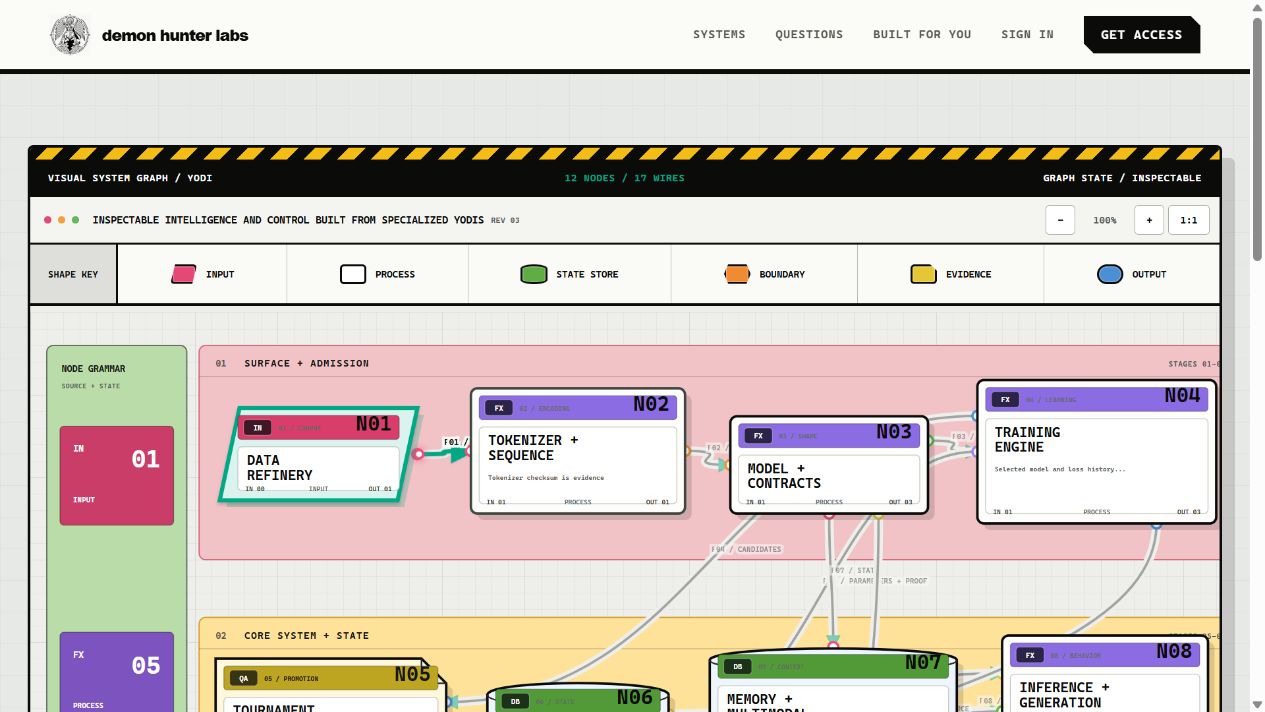 InteractiveSee inside the systemOpen the architecture map ↗
A glimpse inside
Six doors into the machine.
Intelligence above a visible substrate
Yodi describes models and behavior. Yeho validates, schedules, lowers, and executes the computation through CPU-oracle, Vulkan, or Kyber routes.
Eleven bounded responsibilities
Contracts, core, data, model, multimodal, training, tokenizer, memory, inference, serving, and evaluation packages each own a narrow part of the engine.
A team of specialists instead of one opaque giant
Yodi can grow as a bundle of smaller specialists for skills, memories, tools, modalities, and system surfaces, with a typed router and shared workspace coordinating the right team for the job.
Yodi can control any admitted OS capability
Typed adapters can let Yodi observe, propose, and invoke capabilities from one application up through the operating system without giving a model silent authority over the machine.
Data enters with rights and identity
The native data refinery rejects unowned or duplicate content, assigns deterministic identity-based splits and curriculum tiers, and emits a corruption-detecting manifest.
Equal-budget architecture tournaments
Linear, quadratic, and cubic regressors receive the same optimizer and sixteen updates, then compete on a disjoint held-out split with exact rerun requirements.
The door is open