








Private product showcase / Native text and file checkpoint
Superlink
Connect once. Share anything between your chosen devices.
A native private network for selected devices
Why this changes the game
Three reasons to care.
Pair selected devices through explicit network membership.
Send durable messages and verified files through small native windows.
Restart, reconnect, and recover the documented transfer without losing its identity.
Proof today
The current machine, without mythology.
The Windows native checkpoint proves device-code pairing over pinned encrypted sessions, durable text receipts, binary-file verification, destination-collision protection, and two-process restart recovery. A retained 32 MiB transfer checks every byte with both local processes below 8.2 MB peak private memory. The older C++/WebView2 stack remains a separate reference. Full physical-device, WAN, media, inference, and phone gates remain open; local message history is not encrypted at rest.
Teams need to know which devices are connected, what they may share, and whether a message or file actually arrived after an interruption.
The Yeho/YUI replacement puts explicit device pairing, network permissions, durable receipts, and recipient-selected file destinations into an inspectable native application. Broader shared-device experiences build from these boundaries.
The connected stack
Nothing powerful lives alone.
Public Academy
Learn Superlink from the inside.
Every public guide, field lesson, and architecture map for this system is gathered here. No membership is required to study these rooms.
Superlink: selected-device networks and verified file transfer
Explore Superlink's native Yeho device pairing, durable messages, verified binary transfers, and restart recovery. Understand the current Windows checkpoint and future scope.
Open in the Academy ↗02 / Architecture mapSuperlink interactive architecture
Select stations, trace routes, and see which layer owns each important Superlink decision.
Open in the Academy ↗Open the machinery
Follow the whole system.
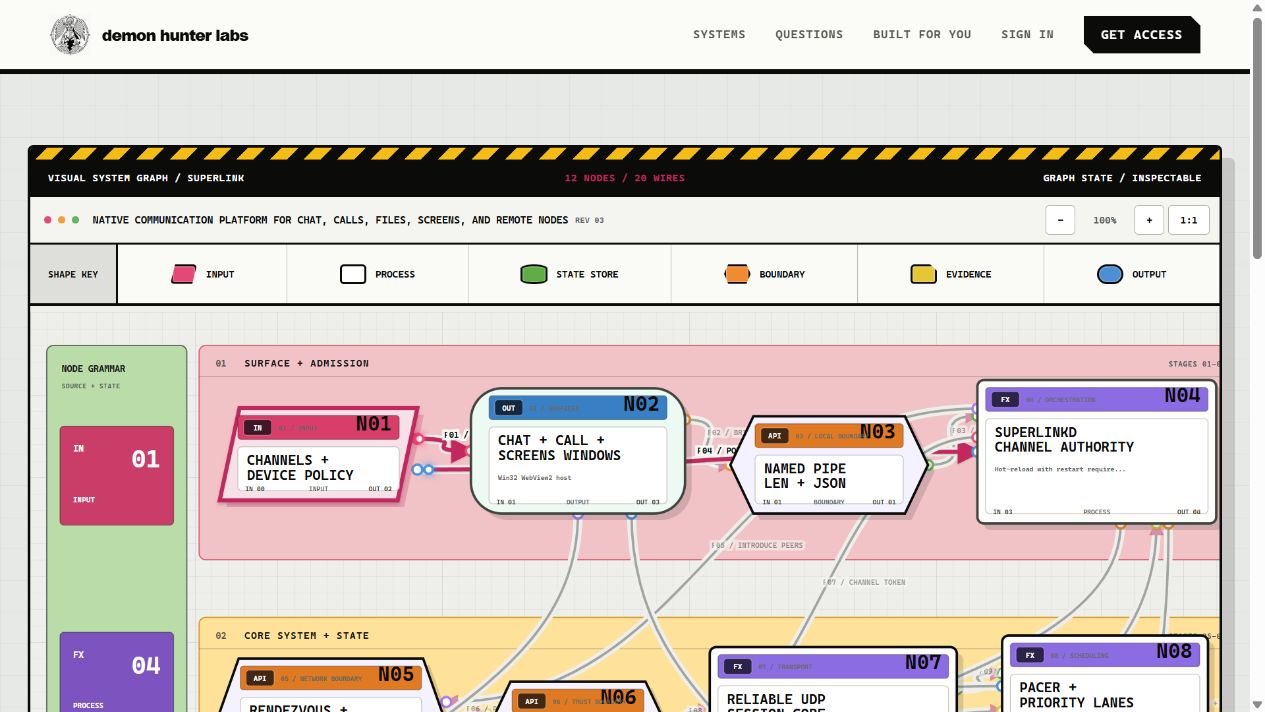
See the route first. Then open the architecture or complete manual when you want every chamber, boundary, and proof.
 InteractiveSee inside the systemOpen the architecture map ↗
A glimpse inside
Six doors into the machine.
The daemon is the communication authority
Superlink separates three disposable WebView2 windows from an always-on local daemon that owns channel state, peer discovery, custom UDP sessions, media, file movement, policy, and headless operations.
Every interaction belongs to a channel
A channel is the shared scope for subscribed nodes, chat, code, file transfers, call state, cameras, screenshares, control requests, and clipboard events rather than a label attached after transport.
Length-prefixed JSON connects clients to the service
superlinkd exposes a Windows named-pipe protocol with request ids, method names, structured responses, and pushed event frames for the UI host and superlinkctl.
A small UDP directory introduces live peers
The rendezvous daemon records channel membership with observed addresses and expirations, then returns peer introductions so clients can attempt NAT traversal and establish direct sessions.
ReliableUDP builds ordered work above datagrams
The shared transport core defines a versioned header, connection and sequence identities, selective acknowledgements, retransmission, fragmentation, reassembly, replay tracking, and MTU-bounded datagrams.
Realtime traffic is protected from bulk work
A lane scheduler, token-bucket pacer, congestion window, AIMD response, priority headroom, and delay limiter decide which datagrams leave next and which late media frames should be discarded.
The door is open