















Second-screen assistance & reference retrievalPublic field guide
Squidly: a second-screen assistant for practice and support
Squidly combines conversation and screen context with approved reference material, then presents assistance on another screen. Its Windows scaffold is a useful starting point for mock interviews, training, and support workflows where the people involved understand how the assistant is being used.
Start with a practical evaluation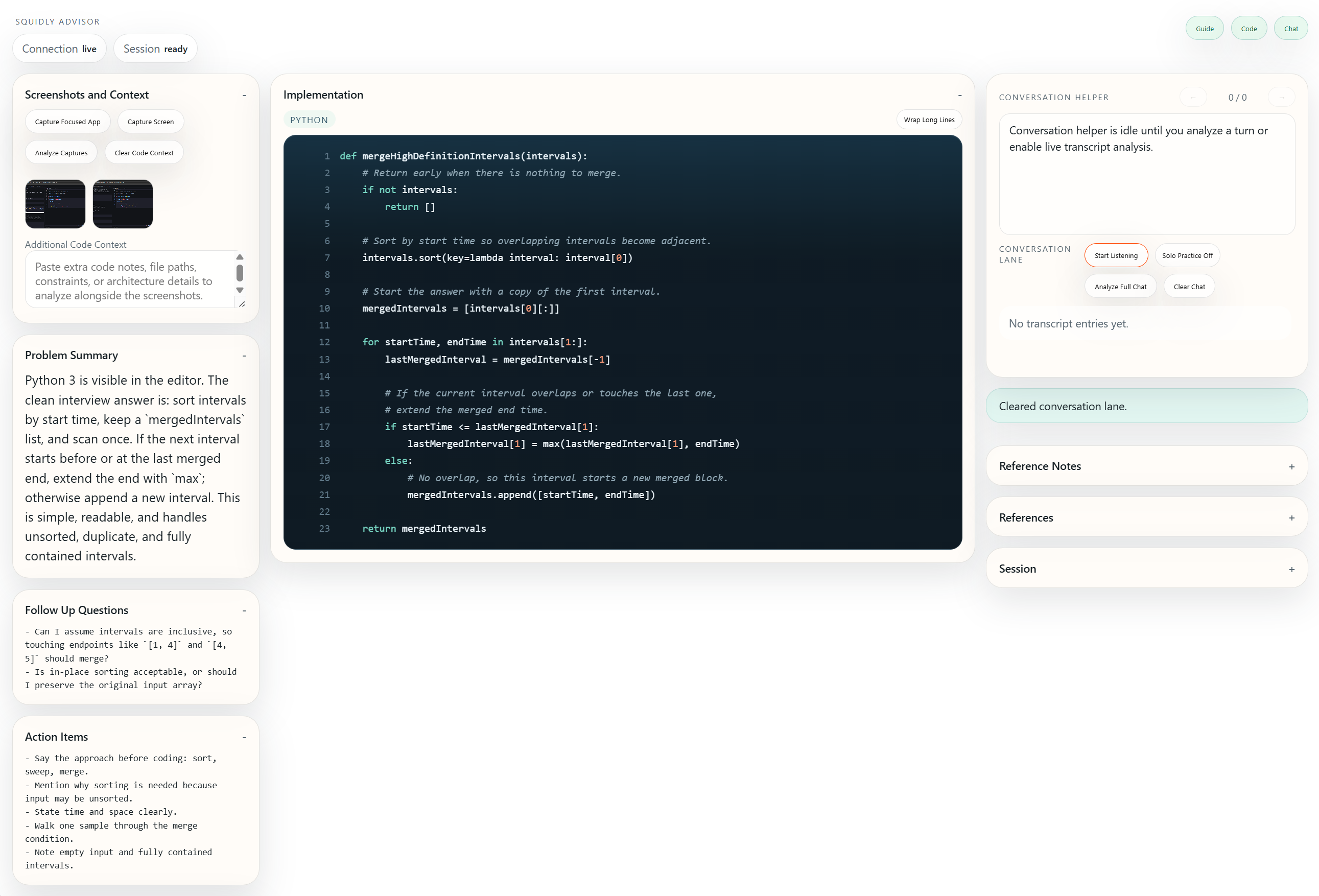
The useful starting point
What Squidly gives your team
A team can investigate how a live question becomes a transcript, a relevant reference, and a short suggestion while retaining evidence about each stage.
Training teams, support-tool developers, and researchers exploring timely assistance from audio, screen context, and approved reference collections.
- 01
Capture the context
Use the configured audio or screen path for a defined session.
- 02
Find a reference
Retrieve from approved material and inspect the source.
- 03
Present useful help
Deliver a concise suggestion to the configured second screen.
A useful suggestion depends on several smaller successes
Audio capture, speech recognition, screen reading, retrieval, and language generation can each fail differently. A correct final-looking answer can hide a bad transcript or an unrelated reference. Squidly's modular scaffold gives a team a way to inspect these stages separately.
Start with a bounded support or practice scenario. Choose known reference material and questions whose answers can be checked. Compare the displayed suggestion with both the actual conversation and the retrieved source, rather than rating fluency alone.
Treat the second screen as part of the workflow
A suggestion arriving too late, at the wrong length, or on an unreadable display may be technically correct but practically unhelpful. Squidly includes a token-gated local HTTP/WebSocket route for its advisor screen. The desktop, local network, and receiving screen all belong in an end-to-end evaluation.
Model and speech routes have different dependencies and data paths. Configure approved material and record which provider actually ran. A known reproduction reaching zero word error is narrow evidence; real microphones, different voices, and unscripted sessions still need human review.
Current public evidence
Tested Windows scaffold
The Windows stack includes WASAPI mic/render capture, OCR, local speech routes, approved-folder retrieval, token-gated local HTTP/WebSocket second-screen delivery, model routing, and retained utterance evidence. A rebuilt direct-streaming harness reached zero word error on its known reproduction; real microphones and unscripted conversations still need human judging.
Explore the project and its evidenceTry one bounded question
Run a short, disclosed practice conversation
A suggested evaluation for your team.
- Use an approved test script and a small reference folder containing verifiable answers.
- Record the actual microphone or system-audio route and configured model provider.
- Ask one supported question and one question the reference material cannot answer.
- Compare transcript, retrieved evidence, suggestion quality, and arrival time.
- Inspect the receiving screen, disconnect it, and observe the session's recovery behavior.
Useful, timely suggestions with traceable sources and explicit handling of missing evidence. Report unscripted failures separately from the known fixture result.
Before you go further
Common questions about Squidly
Is Squidly's speech accuracy proven for every conversation?
No. The retained zero-word-error result belongs to a known reproduction. Different microphones, accents, noise, interruptions, and unfamiliar conversations require their own evaluation.
Can it use a team's own reference material?
The scaffold includes approved-folder ingestion and retrieval. Check the exact source collection, access boundaries, freshness, and attribution in the version you evaluate.
Is the advisor screen a public web service?
The documented scaffold uses a token-gated local delivery path. Internet exposure, organizational access policy, and larger deployments are separate requirements that need explicit design and testing.
From an idea to your first evaluation
Build on what you understand.
Start with Squidly's public evidence. If it fits your team's problem, compare source memberships or tell us what you would like to evaluate.
These guides are free to read. Private source releases follow the membership license. Compare plans and team seats.