

















Native application developmentPublic field guide
Yeho: native programming, YUI, and visual code
Yeho brings a programming language, native compiler, interface system, and visual editing workspace into one connected project. For a team exploring a new application foundation, the useful question is concrete: can we build, understand, and change a small real program without losing sight of how it works?
Start with a practical evaluation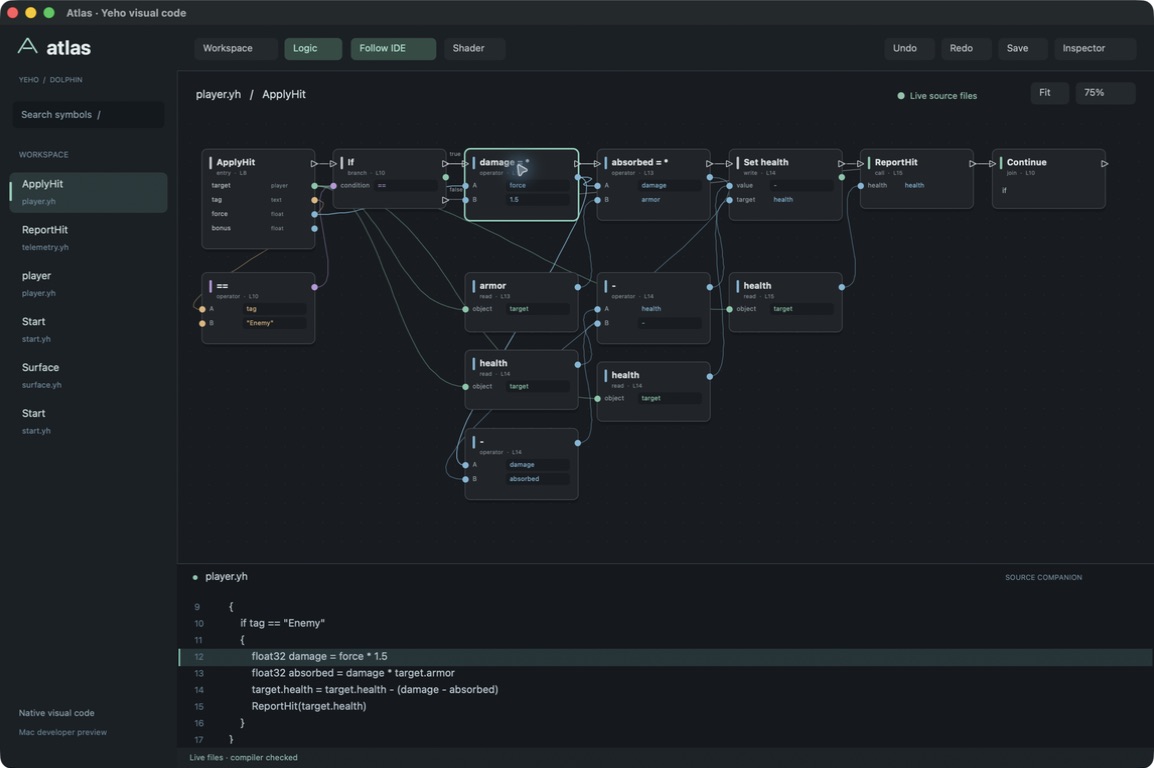
The useful starting point
What Yeho gives your team
Your team can examine the language, compiler, and interface layers together, then adapt the layer that actually limits the application.
Software teams, tool builders, and researchers exploring native applications and visual programming.
- 01
Express the idea
Write Yeho logic and describe the interface in YUI.
- 02
Check the meaning
Forge checks the program before Kyber creates the native artifact.
- 03
Run and inspect
Exercise the application and follow its behavior back to source.
One language, several ways to work
Yeho source describes the program. Forge owns its semantic checks, and Kyber is the direct native compilation path. Ordinary projects on that path do not generate and compile C++. The compiler's remaining C++ and assembly bootstrap is a separate implementation boundary.
YUI describes retained interfaces: controls, layout, interaction, and rendering. Atlas provides a visual view of real Yeho operations and typed connections. These are connected ways of working with a program, rather than a promise that every program can be built by dragging boxes.
Choose a demonstrated target
The published native candidate targets Windows x64. Atlas also has a documented Mac developer preview using the explicit CPU-oracle/AppKit route. That preview does not establish a Mac Kyber SDK. Pick the exact compiler, libraries, operating system, and release before evaluating an application.
The public handbook is the best starting point for syntax, supported features, and small examples. The marketplace adds complete example projects. Reading them is useful before licensing the private repositories or deciding how much of an existing application to move.
Current public evidence
Windows candidate · Atlas Mac preview
The current Windows x64 candidate builds bounded console and YUI apps through Forge and Kyber into native executables. Its provider-neutral graphics contract drives a real OpenGL 3.3 path without leaking backend handles into ordinary Yeho code. Portable compute has a working CPU slice plus a bounded Vulkan 1.2 exact-int32 reference adapter with CPU parity. In the retained counted-loop benchmark, Kyber completed 50 million iterations in a 3.035 ms median versus Python 3.14 at 4,147.313 ms on the same i7-14700K host. That result is workload-specific, not a claim that every Yeho program is universally faster. The candidate also ships project scaffolding, packages, reports, diagnostics, a relocatable SDK and toolchain, custom retained widgets and rendering, and explicit failure when a native construct is not yet supported. Atlas now has a verified Mac developer preview: real Yeho graphs, compatible value rewiring, unsaved VS Code buffer synchronization, Undo, and compiled Dolphin surface previews. Atlas uses the explicit CPU-oracle/AppKit route on Mac; this is not Kyber support for Mac or a new downloadable SDK release.
Explore the project and its evidenceTry one bounded question
Build one window with one useful interaction
A suggested evaluation for your team.
- Start with a public native-window example and read its prerequisite instructions.
- Add a counter or a small calculation with a visible result.
- Resize the window, repeat the action, and close it while work is active.
- Introduce a deliberate type error and inspect the diagnostic.
- Record the compiler and SDK version, build command, and observed behavior.
A reproducible native program whose input, state, drawing, and shutdown your team can explain. Then evaluate a real application requirement on the same toolchain.
Before you go further
Common questions about Yeho
Is Yeho a visual programming language?
Yeho is a source language. Atlas adds a visual editing surface for supported real Yeho graphs, while the source remains part of the workflow. Visual editing and ordinary code are related views, with explicitly bounded current support.
Can I explore Yeho before becoming a member?
Yes. The language handbook, YUI guides, API reference, and marketplace examples are public. Follow each sample's own license and prerequisites. Private repository releases use the separate membership license.
Does the benchmark prove every program will be faster?
No. The retained counted-loop benchmark measures one workload on a named machine. Application performance depends on the code, data, compiler, and runtime path. Measure the workload your team actually needs.
From an idea to your first evaluation
Build on what you understand.
Start with Yeho's public evidence. If it fits your team's problem, compare source memberships or tell us what you would like to evaluate.
These guides are free to read. Private source releases follow the membership license. Compare plans and team seats.