
















Music creation & editable AI ideasPublic field guide
Wave: editable music, instruments, and AI-assisted creation
Wave is a music studio built around keeping a song editable. Notes, rhythm, instruments, automation, and arrangement stay connected while a creator changes the idea. AI-assisted creation is part of that workflow: audition a candidate, decide what to keep, and retain a path back to the original.
Start with a practical evaluation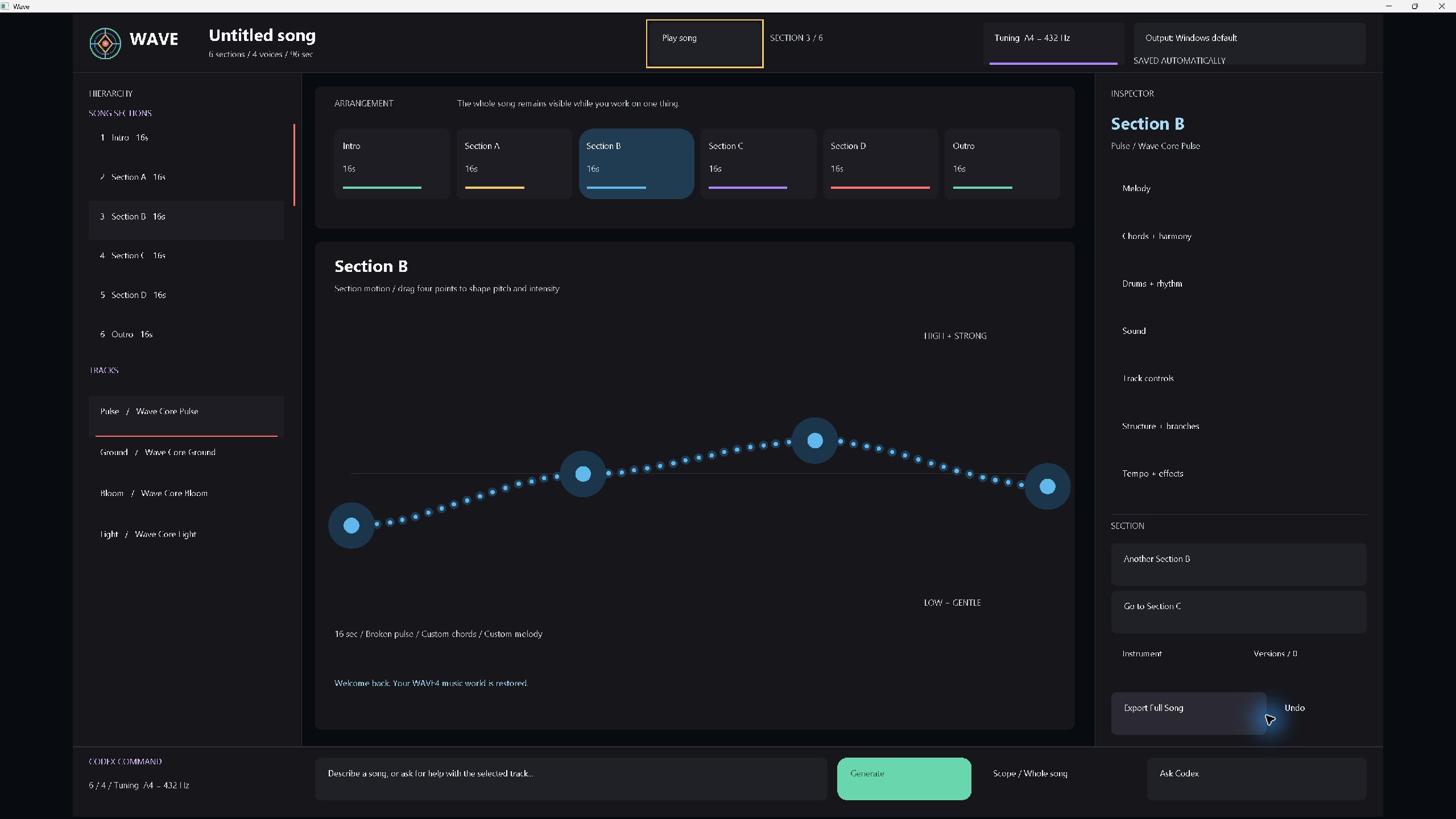
The useful starting point
What Wave gives your team
A generated idea can become material your team understands and changes, with musical structure, instrument choices, and reversible edits still available.
Musicians, music-software developers, creative studios, and teams investigating editable AI-assisted composition.
- 01
Shape the idea
Create or edit notes, rhythm, chords, and an arrangement.
- 02
Audition a change
Compare a sound or generated proposal with the current song.
- 03
Keep and refine
Apply the choice, continue editing, or undo it.
A song is more than a finished audio file
A flattened recording is useful for listening, but it hides the decisions a musician may want to change. Wave keeps musical objects available: note events, track sounds, song sections, and control curves. A team can investigate how these objects connect to playback and export.
The current Windows work includes a native arrangement, note and step editing, sound choices, instrument controls, and reversible effects. Its public screenshots show particular working checkpoints. Confirm which interface and capabilities are present in the member archive you evaluate.
Make AI assistance something you can audition
A useful musical suggestion should be easy to compare with what came before. Wave's creator work separates the original, a preview, the decision to keep it, and undo. That makes it possible to evaluate both musical quality and the integrity of the editing workflow.
The current generation route produces editable notes and native synthesis recipes; it does not establish arbitrary generated vocals. Similarly, separation and transcription should be judged as editable suggestions. Listen to the result, inspect its structure, and keep creative judgment with the person making the music.
Current public evidence
Verified Windows candidate
The Yeho-native Windows candidate verifies prompt-to-six-part song creation, drawable pitch and chords, Living Lines, instrument design, recording/import lineage, Song Lab remix and Digify shapes, guitar-tab export, tuning advice, actual 432/440 playback, typed Yodi proposals, recovery, deterministic masters, premaster, stems, and manifests. Separation and transcription remain editable suggestions.
Explore the project and its evidenceTry one bounded question
Change a phrase and keep the song intact
A suggested evaluation for your team.
- Start with a documented session or create a short phrase with two instruments.
- Edit one note, its duration, and one sound parameter; compare the result by ear.
- Audition a separate generated or edited candidate before keeping it.
- Undo the change and confirm the earlier notes and controls return.
- Save, reopen, and export a supported format, checking the musical result and retained structure.
A creative change that sounds useful, remains editable, and survives undo and recovery. Keep listening judgments separate from timing, file, and state correctness.
Before you go further
Common questions about Wave
Is Wave an AI song generator or an editor?
The working direction combines composition and editing with optional AI proposals. Its distinctive evaluation question is whether a useful suggestion remains understandable and editable inside the song.
Does 432 Hz tuning add a special audio effect?
It changes the tuning reference used for pitch. Wave has documented 432/440 playback behavior. Choose a reference for the musical context and compare the actual sound; the guide makes no health claim about either tuning.
Are VR bands and very large live concerts available now?
Those are future targets. The native music and bounded collaboration evidence should be evaluated separately from a complete VR workspace or large concert service.
From an idea to your first evaluation
Build on what you understand.
Start with Wave's public evidence. If it fits your team's problem, compare source memberships or tell us what you would like to evaluate.
These guides are free to read. Private source releases follow the membership license. Compare plans and team seats.